Tag: gradebook

  • Our 15-Minute Weekly School Technology Check-In

    Our 15-Minute Weekly School Technology Check-In

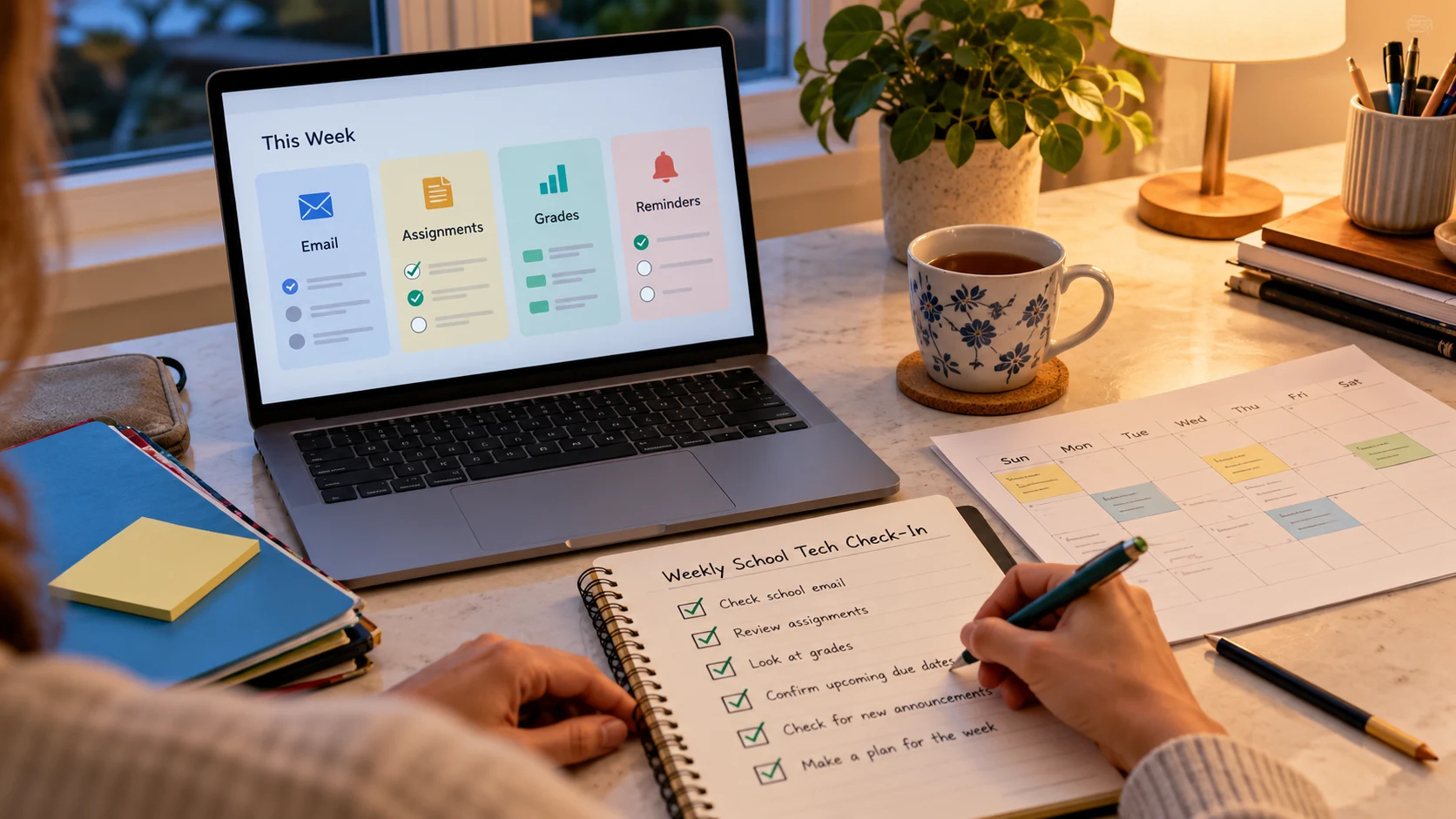
    Our weekly school technology check-in is a simple 15-minute routine to review assignments, grades, and school notifications together.

    School information can come from many different places now. One message may arrive by email. Another update may be posted in Google Classroom or Canvas. Grades may appear in Skyward or another gradebook. A teacher may also send a reminder about a project, form, or upcoming conference.

    For many parents, checking everything every day is not realistic.

    In our home, I have found that weekends are often the easiest time to catch up. During the week, school mornings are busy, evenings can be full, and it is easy to tell myself that I will check the apps later. By the weekend, I sometimes realize that several school updates are waiting in different places.

    That is why a simple weekly school tech check-in can help. It gives parents one regular time to review school information without turning every day into a stressful search.

    1. Pick One Regular Time Each Week

    The first step is choosing a time that is realistic.

    For many families, this might be:

    • Friday evening
    • Saturday morning
    • Sunday afternoon
    • Sunday evening before the new school week

    The exact time does not matter as much as making it consistent.

    Sunday evening works well for many parents because it gives the family time to prepare for Monday. But if Sunday is too busy, Saturday morning may be better.

    The goal is not to spend a long time. Even 15 or 20 minutes can help.

    2. Start With School Email

    Email is often the easiest place to begin because many school updates still arrive there.

    During a weekly check-in, look for:

    • Teacher messages
    • School announcements
    • Conference reminders
    • Forms or attachments
    • Schedule changes
    • Messages about missing work
    • Upcoming events

    If an email needs action, do not leave it buried in the inbox. You can flag it, star it, move it to a school folder, or add a phone reminder.

    A simple rule helps:

    If the email requires action, capture the next step right away.

    3. Check the Main School App

    After email, check the main school app your child uses most.

    This may be:

    • Google Classroom
    • Canvas
    • Schoology
    • Seesaw
    • Another school learning platform

    Look for recent assignments, due dates, teacher comments, and announcements.

    The goal is not to read every old post. Focus on what affects the coming week.

    Useful questions to ask:

    • Is anything due soon?
    • Is there a new project?
    • Did the teacher post instructions?
    • Are there assignments that need parent support?
    • Is anything confusing enough to ask about?

    This step helps parents see what the student may need to work on next.

    4. Review the Gradebook Without Overreacting

    Online gradebooks can be helpful, but they can also create stress if parents check them too often.

    During a weekly check-in, review the gradebook calmly. Look for patterns instead of reacting to every small change.

    Check for:

    • Missing assignments
    • Sudden grade drops
    • Repeated low scores
    • Classes that need attention
    • Assignments marked incomplete

    If your school uses Skyward or another parent portal, the gradebook can show useful information. But remember that gradebooks are not always updated instantly. Sometimes work has been turned in but not graded yet.

    If something is unclear, write it down before asking the student or teacher.

    5. Make a Short Action List

    After checking email, school apps, and the gradebook, make a short list.

    Keep it simple.

    For example:

    • Check Canvas English assignment
    • Ask about missing math worksheet
    • Sign school form
    • Email teacher about conference time
    • Review science project due date
    • Add reminder for Friday deadline

    A short list is better than trying to remember everything.

    If the list gets too long, choose the top two or three items first. Parents and students can easily feel overwhelmed when the list looks endless.

    6. Talk With Your Child Calmly

    A weekly check-in should not feel like an interrogation.

    Instead of starting with, “Why is this missing?” try starting with:

    “Let’s look at what needs attention this week.”

    or

    “I saw a few items in the school app. Can we check them together?”

    The tone matters. If the conversation starts calmly, the student may be more willing to explain what happened.

    Sometimes a missing assignment is not really missing. Sometimes the student submitted it in the wrong place. Sometimes the teacher has not graded it yet. A calm check-in gives the family time to figure it out.

    7. Add Important Deadlines to Your Phone

    If something has a deadline, add it to your phone calendar or reminders.

    This works well for:

    • Project due dates
    • Permission slips
    • Parent-teacher conferences
    • Test dates
    • School forms
    • Assignment resubmission deadlines

    Do not rely only on memory. School information moves too quickly, and parents already have many things to track.

    A good reminder should include the action and the place.

    Example:

    Sunday 7 PM - Check Canvas science project

    or

    Thursday 8 PM - Put signed form in backpack

    Clear reminders reduce last-minute stress.

    8. Save Important Files Right Away

    If you find an important PDF, worksheet, or form during the weekly check-in, save it in one place.

    This could be a school folder on your computer, Google Drive, OneDrive, or another folder you use regularly.

    Useful folder names might be:

    School Files

    2026-2027 School Year

    Forms to Sign

    Needs Attention

    The system does not need to be fancy. It only needs to help you find the file again later.

    9. Keep the Routine Small Enough to Continue

    The most important part of a weekly school tech check-in is keeping it simple.

    A realistic routine might be:

    1. Check school email
    2. Check the main school app
    3. Check the gradebook
    4. Make a short action list
    5. Add reminders for deadlines

    That is enough for most weeks.

    If the routine becomes too complicated, it will be hard to continue. A small routine that happens every week is better than a perfect routine that only happens once.

    Final Thoughts

    Parents do not need to check every school app constantly. That can become stressful and exhausting.

    A weekly school tech check-in gives parents a regular time to review emails, assignments, grades, files, and deadlines. It helps families catch problems earlier without making school technology feel like a daily battle.

    The goal is not perfect control. The goal is to stay aware, reduce surprises, and help the school week start with a little more clarity.


  • Missing Assignments: A Calmer Parent-Child Recovery Plan

    Missing Assignments: A Calmer Parent-Child Recovery Plan

    Missing assignments can create a lot of stress at home. A parent checks the school app or gradebook and suddenly sees several assignments marked as missing. The student may say, “I already turned that in,” or “The teacher has not updated it yet.” The parent may feel worried, frustrated, or unsure what to believe.

    This has happened in our home. I checked the school gradebook and noticed a missing assignment that I had not known about before. It was not always clear whether the work was truly missing, not submitted correctly, or simply not updated yet. That uncertainty made it easy to feel stressed.

    Over time, I realized that missing assignments are easier to handle when I slow down and use a simple routine. The goal is not to argue every day. The goal is to understand what is missing, what needs action, and what can wait.

    1. Check the Gradebook for Patterns, Not Panic

    When parents see the word “missing,” it is easy to react quickly. But one missing assignment does not always mean the student is ignoring schoolwork.

    Sometimes an assignment is:

    • Turned in but not graded yet
    • Submitted in the wrong place
    • Waiting for teacher review
    • Marked missing by mistake
    • Actually not completed

    Before starting a serious conversation, look for patterns.

    Ask yourself:

    • Is this happening in one class or several classes?
    • Are the missing assignments recent or old?
    • Are they small homework tasks or major projects?
    • Is the grade dropping because of one item or many items?

    If the pattern is small, the solution may be simple. If the pattern repeats, it may be time to create a better routine.

    2. Check the Assignment Location

    Missing work often appears in a gradebook, but the details may be somewhere else.

    For example:

    • Skyward or another gradebook may show the missing item.
    • Google Classroom may show the assignment instructions.
    • Canvas may show the module or submission page.
    • Email may include teacher comments.
    • A paper worksheet may still be in the backpack.

    This is why parents should not rely on only one app. The gradebook can tell you something is missing, but the class app often tells you what the assignment actually is.

    A helpful habit is to write down three things:

    1. Class name
    2. Assignment name
    3. Where to find it

    This makes the next step much clearer.

    3. Ask Calm, Specific Questions

    When parents ask, “Why is this missing?” students may feel blamed right away. A calmer question can lead to a better answer.

    Instead of saying:

    “Why didn’t you do this?”

    Try asking:

    “Can we check where this assignment is supposed to be submitted?”

    or

    “Do you remember if this was done on paper or online?”

    or

    “Let’s look at the assignment page together.”

    The tone matters. If the conversation starts as an argument, the student may shut down. If it starts as a problem-solving moment, it is easier to move forward.

    4. Make a Short Missing Assignment List

    If there are several missing assignments, do not try to fix everything at once. That can overwhelm both the parent and the student.

    Create a short list with only the most important items.

    For example:

    ClassAssignmentWhere to CheckNext Step
    EnglishReading worksheetGoogle ClassroomOpen and review
    ScienceLab questionCanvasCheck submission
    MathPractice pageBackpackLook for paper

    A list like this makes the situation feel more manageable. It also helps the student see that the problem is not endless.

    5. Pick One or Two Tasks First

    When a student sees a long list of missing work, it can feel impossible. Parents may want everything fixed quickly, but that often creates more stress.

    A better approach is to choose one or two tasks first.

    Good starting points are:

    • The assignment that affects the grade most
    • The easiest assignment to complete
    • The assignment due soonest
    • The assignment the teacher specifically mentioned

    Finishing one task can create momentum. It also helps avoid the feeling that everything is failing at once.

    6. Use a Weekly Check-In Instead of Daily Arguments

    Checking missing assignments every day can turn school into a constant source of conflict. Some families may need daily checks for a short time, but for many parents, a weekly check-in is more realistic.

    A simple weekly routine could be:

    • Sunday evening: check gradebook
    • Review missing assignments
    • Check Google Classroom or Canvas
    • Write down action items
    • Decide what needs to be done first

    This gives parents a regular time to look without making every evening stressful.

    If there is a serious issue, you can check more often. But for normal school weeks, one scheduled check-in may be enough.

    7. Email the Teacher When Something Is Unclear

    Sometimes parents cannot tell whether an assignment is truly missing. If the student says it was turned in, but the gradebook still shows missing, a short teacher email can help.

    The email does not need to sound accusatory.

    You can write:

    “Hello, I noticed that the gradebook shows the assignment as missing. My child thinks it may have been submitted already. Could you please let us know if we should resubmit it or if it is still waiting to be graded?”

    This kind of message is respectful and clear. It also helps avoid guessing.

    8. Help the Student Build a Small System

    Missing assignments are not always about effort. Sometimes students need a better system.

    A simple system might include:

    • Checking the class app after school
    • Writing assignments in one planner
    • Using phone reminders for due dates
    • Keeping paper worksheets in one folder
    • Reviewing the gradebook once a week

    The system should be simple enough to keep using. If it is too complicated, it will probably stop after a few days.

    9. Keep the Goal Realistic

    The goal is not to make school apps perfect. The goal is to catch problems early enough to respond.

    Missing assignments will happen sometimes. Gradebooks may update slowly. Students may forget. Parents may miss a message. That does not mean everything is failing.

    A calm routine can help parents respond without panic.

    Final Thoughts

    Missing assignments can feel stressful because they appear suddenly and often without the full story. A gradebook may show the problem, but parents still need to check the class app, ask questions, and understand what really happened.

    The best approach is simple: check for patterns, make a short list, choose the first task, and follow up calmly.

    Parents do not need to fight about schoolwork every day. With a small routine, missing assignments can become something to manage instead of something that takes over the whole evening.

  • A Calm Parent-Teacher Conference Checklist for Busy Families

    A Calm Parent-Teacher Conference Checklist for Busy Families

    Parent-teacher conferences are helpful, but they can also feel a little stressful. The meeting time is often short, teachers are busy, and parents may have several questions but not much time to organize them.

    In our family, one of the hardest parts has not always been the meeting itself. Sometimes the difficult part is simply finding a time that works. Between school schedules, teacher availability, parent work schedules, and family routines, it can take several emails just to confirm a meeting time. By the time the conference is finally scheduled, it is easy to feel rushed and unprepared.

    That is why I think parent-teacher conference preparation should start before the meeting is on the calendar. A little organization can make the conversation much easier.

    1. Start With the Main Reason for the Meeting

    Before opening school apps or checking grades, it helps to ask one simple question:

    What do I most want to understand from this meeting?

    The answer does not need to be complicated. It might be:

    • Is my child keeping up with assignments?
    • Is there a pattern in missing work?
    • Is my child participating in class?
    • What should we focus on at home?
    • Is there one skill that needs extra support?

    When I do not write this down first, I tend to collect too much information. Then the meeting becomes scattered. A clear main question helps me listen better and ask better follow-up questions.

    2. Check the School Gradebook Before the Meeting

    If your school uses a parent portal such as Skyward, PowerSchool, Infinite Campus, or another gradebook system, it is useful to check it before the conference.

    I do not recommend checking every small grade with panic. A single low score does not always tell the whole story. Instead, look for patterns.

    For example:

    • Are missing assignments showing up often?
    • Are quiz scores lower than homework scores?
    • Is one class much harder than the others?
    • Are grades improving or dropping over time?
    • Are there assignments marked missing that may have already been turned in?

    If your school uses Skyward, the Gradebook section can be helpful because it shows assignments, scores, and missing work in one place. Before a conference, I would write down only the items that need clarification. The goal is not to challenge every number. The goal is to understand what is happening.

    3. Review Google Classroom, Canvas, or Other Class Apps

    Many teachers now use Google Classroom, Canvas, Schoology, or other learning platforms. These tools can be very useful, but they can also make school information feel spread out.

    Before a conference, I like to check the class app for three things:

    1. Recent assignments
    2. Teacher comments or instructions
    3. Upcoming due dates

    This helps me avoid asking questions that already have simple answers online. It also helps me ask more specific questions.

    Instead of saying, “How is my child doing?” I can ask:

    “ I noticed the last writing assignment was difficult. What part of the assignment should we work on at home?”

    That type of question usually leads to a better conversation.

    4. Look Through Recent Teacher Emails

    Teacher emails are easy to miss, especially when school messages, app notifications, and personal emails are all mixed together.

    Before a parent-teacher conference, I try to search my email for the teacher’s name or class name. This helps me find earlier messages that may still matter.

    Useful things to look for include:

    • Missing assignment reminders
    • Behavior or participation notes
    • Test or project announcements
    • Schedule changes
    • Previous teacher suggestions

    This step is especially helpful when meeting times are hard to arrange. If there were several emails just to schedule the conference, important details can get buried in the conversation thread. Searching the teacher’s name helps bring everything back into one place.

    5. Write Down Questions Before the Meeting

    A short list of questions can make the meeting much more productive.

    I usually think of questions in three groups:

    Academic questions:

    • What skill should we focus on most right now?
    • Are missing assignments affecting the grade?
    • Is my child understanding the material in class?

    Organization questions:

    • Is my child turning in work on time?
    • Does my child need help tracking assignments?
    • Which app should we check most often?

    Support questions:

    • What can we do at home?
    • Is there a resource or routine you recommend?
    • Should we follow up again in a few weeks?

    It is better to bring five clear questions than a long list that cannot fit into the meeting time.

    6. Keep Notes During the Conference

    During the meeting, I try to write down only the most useful points. I do not need to record every sentence. I mainly want to capture action items.

    For example:

    • Check Google Classroom every Monday
    • Review missing assignments on Friday
    • Email teacher if a grade still looks incorrect
    • Help child start writing assignments earlier
    • Schedule a follow-up meeting if needed

    After the conference, these notes become the plan. Without notes, it is easy to leave the meeting feeling encouraged but then forget the details a few days later.

    7. Send a Short Follow-Up Email

    After the conference, a short email can help everyone stay on the same page.

    It does not need to be formal or long. Something like this is enough:

    “Thank you for meeting with me today. I appreciate your time. I will help my child check assignments more regularly and focus on the writing practice we discussed. Please let me know if there is anything else we should watch for.”

    This kind of message is useful because it confirms the plan and keeps communication open. It also gives the teacher a clear sense that the parent is trying to follow through.

    8. Make the Plan Simple Enough to Continue

    The biggest mistake is creating a plan that is too complicated. A conference can give parents a lot of information, but the follow-up routine should be simple.

    For our family, the most realistic plan is usually something small:

    • Check the gradebook once or twice a week
    • Look at Google Classroom or Canvas on a regular day
    • Save important teacher emails
    • Keep one short list of questions for follow-up

    A parent does not need a perfect system. A simple routine that continues is better than a complicated system that stops after one week.

    Final Thoughts

    Parent-teacher conferences work best when parents arrive with a clear picture, a few focused questions, and a simple follow-up plan.

    School apps, gradebooks, and emails can feel overwhelming when they are scattered across different places. But when parents use them before the meeting, they can make the conversation much more useful.

    The goal is not to control every detail. The goal is to understand what is happening, support the child better, and make the next step clear.

  • Checking Skyward Without Letting Every Grade Cause Stress

    Checking Skyward Without Letting Every Grade Cause Stress

    Online gradebooks can be very helpful for parents, but they can also create stress.

    In our home, Skyward is one of the places I check for school grades. When I go into Skyward and open the Gradebook, I can see class grades, assignments, scores, and sometimes missing work. That information is useful because it helps me understand how school is going.

    But there is also a problem. When grades are easy to check, it becomes tempting to check them too often.

    A gradebook can show helpful information, but it does not always show the full story. A low score may be temporary. An assignment may be entered before the teacher finishes grading. A missing assignment may already be turned in but not updated yet. If parents react too quickly, the gradebook can create more worry than clarity.

    That is why it helps to have a simple grade-checking routine. The goal is not to ignore grades. The goal is to check them calmly and use the information in a helpful way.

    1. Choose a Regular Grade Check Time

    Instead of checking grades randomly throughout the day, choose a regular time.

    For example, some parents may check Skyward Gradebook once or twice a week. Others may check on Sunday evening before the school week starts.

    A regular check time can reduce stress because you are not constantly reacting to every small change.

    A simple routine might be:

    • check grades once during the week
    • check again before the weekend
    • look for missing work
    • write down questions
    • avoid checking repeatedly in one day

    This makes the gradebook feel like a tool, not a source of constant pressure.

    2. Look for Patterns, Not Just One Score

    One low score does not always mean there is a big problem.

    When checking the gradebook, it helps to look for patterns. Is the same class showing repeated missing work? Are quiz scores dropping over time? Is one type of assignment causing trouble?

    A single score may be disappointing, but a pattern gives better information.

    For example, if one math quiz score is low, it may simply mean the student had a difficult day. But if several math assignments are missing or several quizzes are low, that may be worth a closer look.

    Parents can use the gradebook to notice patterns without overreacting to every update.

    3. Check Missing Assignments Carefully

    Missing assignments are one of the most useful things to check in an online gradebook.

    In Skyward Gradebook, parents may see whether an assignment is marked missing, late, incomplete, or not entered yet. The exact wording depends on the school and teacher.

    Before getting upset, it helps to ask a few questions:

    • Was the assignment actually missing?
    • Was it turned in but not graded yet?
    • Did the student submit it online?
    • Was it a paper assignment?
    • Does the teacher update grades weekly or less often?

    Sometimes the gradebook is correct. Sometimes it simply has not been updated yet.

    This is why a calm check is better than an immediate reaction.

    4. Talk With Your Child Before Sending an Email

    If something looks wrong in the gradebook, it is often helpful to talk with your child first.

    A simple conversation can give context. You might ask:

    • Do you know about this assignment?
    • Did you turn it in?
    • Was it online or on paper?
    • Did the teacher mention when grades will be updated?
    • Do you need help finishing it?

    This can prevent unnecessary emails to the teacher.

    Of course, if there is a repeated issue or something is unclear, contacting the teacher may be appropriate. But starting with a calm conversation at home can make the next step easier.

    5. Use the Gradebook With the School Platform

    The gradebook does not always include all assignment details.

    Sometimes the grade appears in Skyward, but the instructions are in Google Classroom, Canvas, Schoology, or another school platform. A missing assignment may need to be checked in the classroom app. A project deadline may be clearer in Canvas or Google Classroom than in the gradebook.

    That is why it helps to connect the tools:

    • use Skyward Gradebook to check grades and missing work
    • use Google Classroom or Canvas to check assignment details
    • use email for teacher communication
    • use the family calendar for important due dates

    Each tool has a different purpose. The gradebook is useful, but it should not be the only place parents check.

    6. Avoid Checking Grades Too Late at Night

    This may sound small, but timing matters.

    Checking grades late at night can make problems feel bigger than they are. If a parent sees a missing assignment or low score right before bedtime, it can create stress for the whole family.

    It may be better to check grades when there is time to think clearly and respond calmly.

    For example, checking in the afternoon or early evening may give the family time to ask questions, look at the assignment, and make a plan.

    A gradebook is more useful when parents have enough time and energy to respond thoughtfully.

    7. Make a Small Action List

    After checking grades, it can help to make a short action list.

    Do not write down everything. Focus only on what needs attention.

    For example:

    • ask about missing science assignment
    • check Canvas for essay instructions
    • review math quiz mistakes
    • email teacher if assignment status does not change
    • add project due date to calendar

    This keeps the grade check practical.

    Instead of simply feeling worried, parents can turn the information into a few clear next steps.

    8. Remember That Grades Are Information, Not the Whole Child

    This is important.

    Grades matter, but they are not the full picture of a student. A gradebook does not show effort, anxiety, confusion, improvement, executive function challenges, communication difficulties, or what happened during the school day.

    Online grades are useful information, but they are still only one part of school life.

    For parents, the goal is to support the child, not just chase numbers. A lower grade can be a signal to ask questions, offer help, or look for a better routine.

    It does not need to become a daily source of fear.

    Final Thoughts

    Skyward Gradebook and other online gradebooks can help parents understand school progress. They make it easier to see grades, missing work, and assignment updates.

    But checking grades too often can create stress. A simple routine can help parents use the gradebook in a calmer way.

    Choose a regular grade check time. Look for patterns instead of reacting to one score. Check missing assignments carefully. Talk with your child before sending an email. Use the gradebook together with Google Classroom, Canvas, or other school platforms.

    The goal is not to watch every grade change immediately. The goal is to use school technology in a way that helps the family stay informed without feeling overwhelmed.